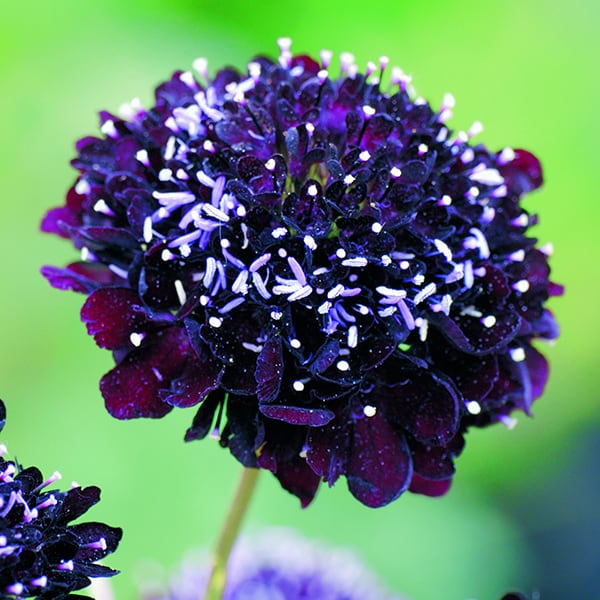
Scabiosa atropurpurea 'Black Knight' is dramatic. Bold, dark plum pincushion-like flowers, some with sharply contrasting white stigmas, appear from summer to autumn. Bees and butterflies are drawn to them, so are humans! They’ve got almost everything: colour, scent, a long flowering season, cutting and, if so inclined, a dye plant too!
🌸 Flowering: June to October
📏 Height: to 90cm
🌿 Short-lived perennial, grow as an annual
Sow: two approaches to choose from. Under cover early or late in the year, in trays, lightly cover the seeds, keep at 18-25C. Pot up when large enough and grow on until frost is past and you can plant them out. Or direct sow, in April or May, thinning seedlings 15-30cm apart.
Grow: they like well-drained soil in a sunny spot. Regular deadheading or cutting will prolong flowering. Cutting back faded flower stems in autumn helps maintain plant health. A light mulch can protect the roots over winter. However, for reliable flowers it’s best grown as an annual.
Enjoy: I’ve done some dyeing, you need a lot of flowers, and that is something that Black Knight does very well. But for pure pleasure seeing these amongst the other flowers is drama enough for me.
🏡 In your garden
• Urban and courtyard gardens
• Coastal gardens
• Cottage and informal gardens
• Patio and container plants
• Meadow and naturalistic planting
• Pollinator planting
• Flower borders and beds
• Cutting gardens
✂️ Cut flower
• Fresh vase life of up to 10 days
• Cut when buds are just beginning to open and pop into lukewarm water
• Strip the lower leaves and cut the stem at a diagonal before putting in a vase
• Change the vase water and trim the stems every couple of days
• Fabulous paired with contrasting bright or lime-green foliage and flowers
🐝 Pollinator friendly
• RHS Plants for Pollinators recommended
• Honeybees, bumblebees, solitary bees and hoverflies frequently visit
• They attract a range of butterflies, so you could see the garden favourites (Small Tortoiseshell, Red Admiral, Painted Lady, Peacock, Meadow Brown and Common Blue) stopping by
🎨 Natural dye plant
• These can yield a wide range of shades ranging from deep greens and teals to blues, purples, and pinks. It all depends on the mordants and pH modifiers used
• Dried flower heads are more concentrated. Follow a low-and-slow route, simmering (not boiling) for an hour before leaving the flowers to steep overnight before straining.
• Start with tannin then alum mordants
• Add the wet fabric to the dye bath and bring it back to a gentle simmer for an hour, then leave it in the pot to cool completely before hanging in the shade to dry
• Even then the colours are considered fugitive. The tones shift and fade over time when exposed to sunlight and frequent washing. A small amount of iron water can improve the lightfastness but will shift the colour.
• For pinks and maroons add a splash of white vinegar to the dye bath, for the greens add a little sodium bicarbonate. Remember that these colours will shift again if you then use iron water.
📜 Traditional uses
• The name Scabiosa comes from the Latin scabies, meaning “itch”, reflecting the plant's long-standing traditional use for treating itchy skin conditions.
• This is a historical use only, not a recommendation for medicinal use.


 Save
 Sold out


