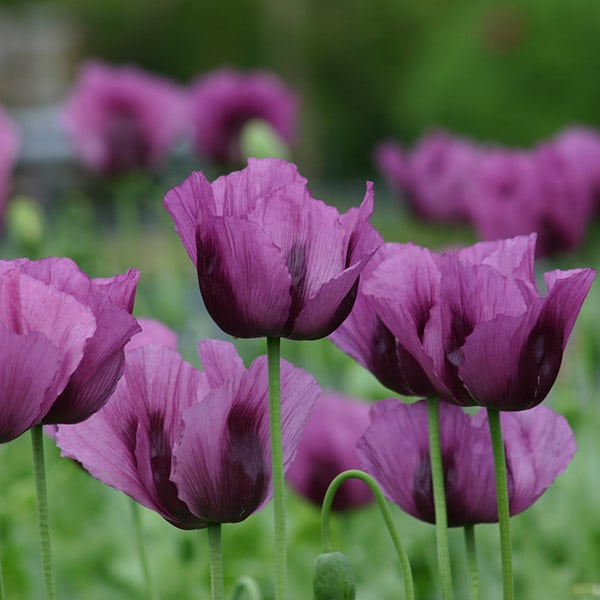
Papaver Hungarian Blue has gorgeous amethyst petals with deeper plum markings. It’s not blue at all! The flowers seem impossibly large on those very slender silvery-green stems. Don’t be fooled by its apparent delicacy. Like other Papaver somniferum, once it has found a sunny spot it likes, it will happily make itself at home, reseeding if you let it.
🌸 Flowering: summertime
📏 Height: to 90cm
🌿 Annual
💧 Drought tolerant once roots are established
Sow: in prepared ground where they are to flower, during March to June. Lightly rake to cover the seeds (it’s a bit like tickling them in). Germination usually takes about 3 weeks. Alternatively, you can sow August to October (protect these in colder and wetter places with cloches over the winter) to flower in the following late spring.
Grow: thin to 20-30cm apart so young plants have room to grow. Flowering is in the summer. Collect the pods when they have dried or leave some to self-seed.
Enjoy: for me, it’s all about that lovely colour wafting about in the garden.
🏡 In your garden
• Cottage and informal gardens
• Naturalistic planting such as meadows
• Gravel gardens and prairie planting
• Flower borders and beds
✂️ Cut flower
• Fresh vase life 2 to 3 days
• Cut in the cracking bud stage and sear the ends in boiling water for several seconds.
• The seed pods are decorative, fresh or dried.
🐝 Pollinator friendly
• The open, bowl-shaped flowers make the pollen easy for visiting bees to reach
🍴 Edible
• Only the fully dried mature seed is edible. When the pods are completely dry the seeds can be tipped out.
• Used in bread and cakes
• 'Hungarian Blue' is a specific cultivar of the breadseed poppy.
💡 Did you know?
Ancient flowers can have some wonderful other names. Let’s explore three for Papaver somniferum.
Balewort is an ancient name with a rather ominous meaning. "Bale" is from an Old English word associated with evil, misery, injury or harm, while "wort" means plant.
Llysiau'r cwsg is the authentic Welsh name for the plant. It was given in a Welsh-English dictionary published in 1688, so the name was established by then. It translates to "herbs of sleep," matching the Latin somniferum ("sleep-bringing").
Marble flower is another old name for Papaver somniferum, although exactly how this one came about seems to have been lost along the way. Could those smooth, rounded seed pods be behind this one?
⚠️ CAUTION
Only fully mature seed collected from completely dried pods is edible. The rest of the plant is harmful if eaten.


 Save
 Sold out


