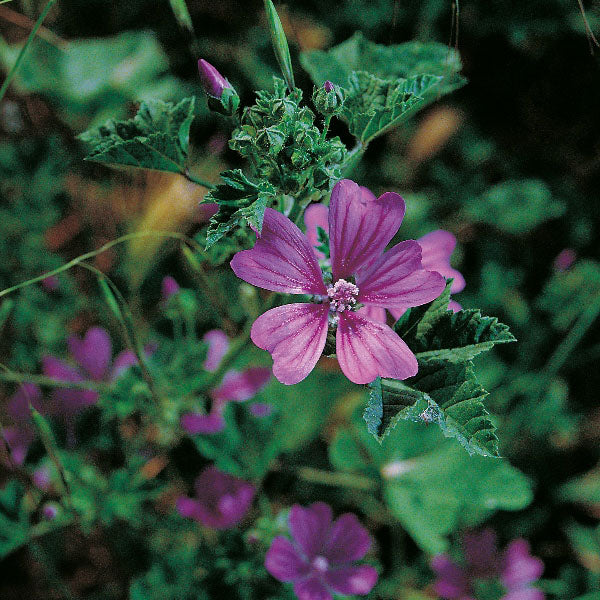
Common Mallow, Malva sylvestris, is one of our long-established naturalised wildflowers. Its pink-purple flowers are streaked with darker veins, little signposts guiding visiting insects towards the nectar. It's a plant that's been growing alongside people for a very long time too, turning up around roadsides, field edges, old settlements and disturbed ground.
From this wildflower came garden varieties such as Mallow 'Zebrina', but there's very much a place in our gardens for the beautiful original.
🌸 Flowering: June to the first frosts
📏 Height: to 1.5m
🌿 Perennial
💧 Drought tolerant when established
Sow: in spring or late summer in pots or modules of moist (not wet) seed compost. Cover with perlite or vermiculite and seal in a plastic bag. At about 20°C germination takes 1-3 weeks but can be slower. Uncover once germinated.
Grow: harden off and plant out about 50-60cm apart. They like to be in a sunny position with moist but well-drained soil. Once established, it’s deep taproot makes it drought tolerant and it can grow happily near an established hedge where other plants can struggle.
Enjoy: don't overlook the original in favour of its showier garden descendants. Those pink-purple flowers with their darker stripes have been growing alongside people for centuries, and they still earn their place in a garden today.
🐞 Wildlife friendly
The Mallow Moth (Larentia clavaria) caterpillars use common mallow as their main food plant. You can see the adults flying in September and October. They can be found throughout England, Wales and into southern Scotland
Firebugs (Pyrrhocoris apterus) are rather extraordinary red-and-black visitors to look out for. Mallow is one of their food plants and they feed particularly on the seeds. Once extremely rare in Britain and confined to a long-established colony in Devon, Firebugs have now appeared in several other parts of southern England. They may look rather alarming, but they're harmless to us.
And here's another claim to fame: the Firebug is the only member of its family, the Pyrrhocoridae, found in Britain.
And then there are the visitors you're much more likely to recognise. Honey bees, red-tailed bumblebees, hoverflies and butterflies such as Small Whites are all drawn to the nectar-rich flowers.
RHS Plants for Pollinators recommended
🌿 Habitat
Naturalised wildflower, archaeophyte
• Dry disturbed, nutrient-rich soils
• Roadside verges
• Waste ground
• Path edges
• Hedgerows and field borders
• Coastal areas
🏡 In your garden
• Cottage and informal gardens
• Meadows
• Wildlife gardens
• Pollinator plantings
• Flower borders
• Sunny side of walls and hedges
• Coastal gardens
🍴 Edible
There is a long history of Common Mallow as a traditional food in the UK. Each part has an edible use: its leaves, flowers, stems, roots and seeds. Please don’t wild forage, grow your own!
💡 Did you know?
Common Mallow has been growing alongside people for centuries. Because it thrives on disturbed ground and has such a long association with human settlement, wild clusters can sometimes act rather like a living map of past human activity. Archaeobotanists and ecologists can use plants like this as clues to where people once lived, travelled and cultivated the land.
It is classed as an archaeophyte, one of the ancient introductions that became established in Britain through our very long history of moving, growing and using plants.


 Save
Save Sold out


