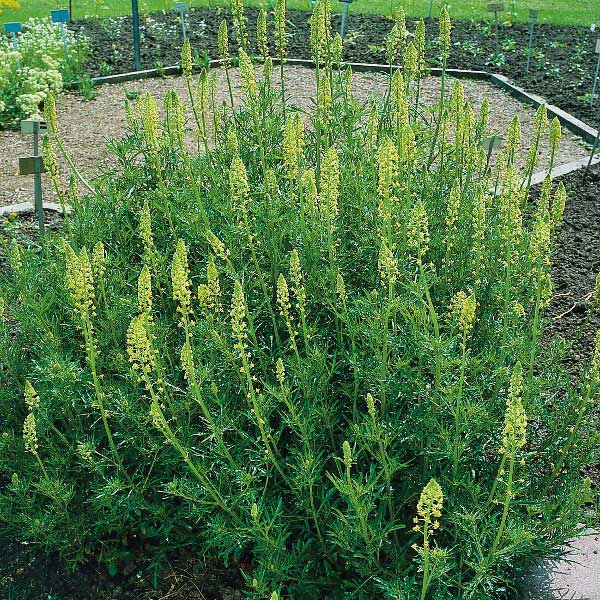
Dyers Weld (Reseda luteola), also known as Dyer's Rocket, has been valued as a dye plant since Roman times, producing the brilliant, clear yellow for which it became famous. It spends its first year as a fairly unassuming rosette of long green leaves, then comes the rocket bit! In its second year tall flower spikes shoot upwards, carrying masses of tiny yellow flowers through summer.
🌸 Flowering: June to August
📏 Height: to 1.5m
🌿 Biennial
Sow: from March to April or July to September, ideally where you want the plants to grow. The tiny seeds need light to germinate, so sow thinly onto finely prepared soil and don't cover them. You can also sow into modules, but Dyers Weld dislikes root disturbance, so transplant the young plants carefully.
Grow: choose a sunny spot with well-drained soil, preferably on the alkaline side. Don't be tempted to feed it too generously. Weld grown with plenty of nitrogen may look lush, but can produce less dye. Keep young plants watered while they establish, particularly during hot, dry weather.
Enjoy: the first year is all about leaves, but be patient. In its second year those low rosettes send up tall, slender flower spikes that can reach 1.5m. The flowers themselves may be small, but en masse they give the plant a lovely light, airy look. And when flowering starts, that's when your dye harvest is almost ready.
🎨 Natural dye plant
• Weld produces a brilliant, clear yellow with very good lightfastness and has long been regarded as one of the finest yellow dye plants.
• Almost all of the plant above ground can go into the dye pot, including the leaves, flowers, seed capsules and stems. Leave the roots in the ground.
• Harvest just after flowering begins, when the dye content is at its best. The plants can be used fresh or dried and stored for later.
• For a first dye bath, aim for roughly twice the weight of fresh Weld to the dry weight of fabric, or about the same weight of dried Weld as fabric.
• For cotton, linen or hemp, prepare the fabric first with a tannin bath followed by an alum mordant.
• Chop the Weld, cover with water and simmer gently for about an hour before allowing it to cool and straining. If you have soft water, adding a little chalk can help as Weld gives better results in harder water.
• Add your prepared, pre-soaked fabric to the dye bath, slowly bring to a simmer for about an hour, then turn off the heat and leave to cool overnight.
• The dye bath can be used again for paler shades.
🏡 In your garden
• Cottage and informal gardens
• Wildlife gardens
• Gravel gardens
• Flower borders and beds
• Pollinator plantings
• Cutting gardens
• Dyers gardens
🐝 Pollinator friendly
• The small flowers provide pollen and nectar for visiting insects
• Particularly valuable to yellow-face bees. The mignonette yellow-face bee (Hylaeus signatus) has a strong association with Weld and other Reseda species
✂️ Cut flower
• Vase life of 5 to 7 days
• The flower spikes have a sweet, honey-like fragrance
📜 Traditional uses
Weld was one of the most important yellow dye plants of the Roman world, prized for the brilliant, lasting yellow it produced.
It was used to dye the robes worn by the Vestal Virgins and was also associated with Roman wedding garments.
Centuries later Weld remained an important European dye plant, used for textiles and to make yellow lake pigments.
💡 Did you know?
The yellow colouring compound found in Weld is called luteolin.


 Save
Save Sold out


