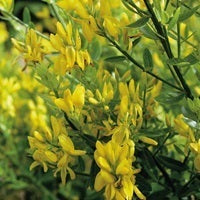
Dyers Greenweed (Genista tinctoria) is a UK native, although you're unlikely to come across it very often in the wild. Bright yellow flowers cover the dark green stems from June to September, providing pollen and nectar for bees and an important foodplant for a number of moth species. Historically important as a dye plant, it produces strong, warm yellows from its flowering stems.
🌸 Flowering: June to September
📏 Height: 60-90cm
🌿 Hardy deciduous shrub
💧 Drought tolerant once established
Sow: in autumn in pots in a cold frame or under a cloche, allowing the seeds to experience the natural winter cold before germinating as temperatures rise in spring. Alternatively, soak stored seed in warm water for 24 hours and sow in February, placing the pots in a cold frame or under a cloche.
Grow: transplant while the plants are still young as Dyers Greenweed dislikes root disturbance. Choose a sunny position with well-drained soil. Once established it needs little fuss and is quite at home in a drier part of the garden.
Enjoy: this isn't just a plant for the dye pot. Those bright yellow flowers against the dark green stems make a lovely splash of summer colour, particularly in a sunny, slightly wilder corner of the garden. And knowing there's a centuries-old dye plant growing there makes it that little bit more interesting.
🎨 Natural dye plant
- The flowering stems produce strong, warm yellow shades. Rather than picking individual flowers, snip the flowering stem tips for your dye pot.
- You'll need plenty of plant material. For a first dye bath, aim for roughly one and a half to twice the weight of fresh flowering tips to the dry weight of fabric.
- For cotton, linen or hemp, prepare the fabric first with an aluminium lactate mordant. Dyers Greenweed takes better with a mordant than a soymilk binder.
- Dyers Greenweed benefits from slow extraction. Soak the flowering tips overnight, then bring them to a low simmer for an hour before straining.
- Add a little chalk to strengthen the yellow, then add the prepared, pre-soaked fabric and simmer gently for another hour. Leave it to cool in the dye bath overnight; leaving it for several days can produce a stronger colour.
- The dye bath can be used again for a paler shade.
- The yellow has good lightfastness.
🏡 In your garden
- Cottage and informal gardens
- Wildlife gardens
- Native plantings
- Banks and slopes
- Gravel gardens
- Dyers gardens
🐝 Pollinator friendly
The flowers provide pollen and nectar for bees.
🐞 Wildlife friendly
An important foodplant for several scarce insects, including five rare or nationally scarce micro-moths for which Dyers Greenweed is the sole or primary foodplant.
📜 Traditional uses
- Dyers Greenweed has a very long history as a dye plant. Remains of the plant have been found during excavations at Viking-age Coppergate in York.
- Fabric dyed with its strong yellow and then be overdyed with blue from woad to produce green, traditionally known as Lincoln Green.
- The young shoots and stems were also once bundled together to make sweeping brooms, giving the plant another of its common names, Dyer's Broom.


 Save
Save Sold out


