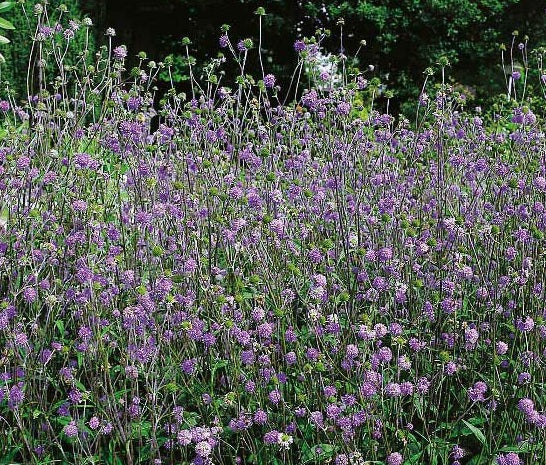
Devil’s-bit Scabious (Succisa pratensis) is a British native wildflower with mauve-purple pompoms bobbing about on slender stems from summer into autumn. It is wonderfully rich in nectar, and its wild heritage turns out to suit gardeners rather well too.
🌸 Flowering: summer into autumn
📏 Height: 50-100cm
🌿 Perennial
Sow: in situ from September to November. Scatter the seed, rake in very lightly and firm with the back of the rake. Or sow from March to May, first mixing the seed with damp sand and chilling it in the fridge for a few weeks. Then sow on the surface of a tray of seed compost, press gently into the surface and water. Cover with glass or plastic until seedlings appear. Prick out into small pots when large enough and grow on before planting out. Germination can be slow and sporadic, so don't give up on the seed tray too quickly!
Grow: happy in damp to reasonably well-drained soil in sun or partial shade. It forms clumps of low, flat leaf rosettes with the flower stems rising above. The rosettes will even tolerate being mown over, which makes this an interesting choice for wilder areas of lawn.
Enjoy: let it settle in and make itself at home. The flowers bob above the lower foliage for weeks, bringing plenty of insect visitors with them. And don't be too quick to tidy everything away when flowering finishes. Leave some seed heads standing for visiting birds and you may find a few new plants popping up too. A wildlife garden can be allowed a few untidy corners!
🐞 Wildlife friendly
Ecologically important for the Marsh Fritillary (Euphydryas aurinia), one of our most threatened butterflies. Its caterpillars feed almost exclusively on Devil's-bit Scabious. Marsh Fritillaries live in colonies and rarely disperse far, so growing this in your garden is unlikely to help them directly. It does, however, tell quite a story about just how important one plant can be within the right habitat.
Caterpillars of another rarity, the bee-mimicking Narrow-bordered Bee Hawk-moth (Hemaris tityus), also feed mainly on Devil's-bit Scabious.
Look out for some familiar visitors too. Its nectar-rich flowers attract plenty of insects, including bees, hoverflies and moths, while Peacock, Red Admiral, Small Tortoiseshell, Small Copper and Small White are amongst the butterflies you might actually spot feeding on the flowers.
And the benefits don't stop with the insects you see on the flowers. A patch rich in bees, moths, hoverflies and other insects becomes part of the wider food chain, with all those insects providing food for birds and bats. Your patch may be small, but add it to all the other flower-rich patches and together they make a much more useful habitat.
RHS Plants for pollinators recommended
🌿 Habitat
British native wildflower
• Damp grassland and hay meadows
• Heathland
• Marshy pasture
• Woodland clearings and edges
🏡 In your garden
• Cottage and informal gardens
• Wildlife gardens
• Pollinator plantings
• Bog gardens, pond edges and damp gardens
• Woodland edges or hedge sides that do not dry out completely in summer
📜 Traditional uses
Devil's-bit scabious has centuries of association with herbal remedies and was traditionally used for skin conditions like scabies and even the sores of bubonic plague. Its Latin name comes from scabere, meaning "to scratch".
🎨 Natural dye plant
Another old use that has largely disappeared. In Ireland and Scotland, Devil's-bit Scabious was traditionally used as a dye plant, with records of the leaves being treated rather like woad to produce blue.
💡 Did you know?
This is a plant of many names. Blue Buttons, Blue Kiss, Fore-Bitten-More, Ofbit, and Ofbitten are some of the regional ones you might know. And the ‘bit’? Well, one story is that the Devil bit the root, jealous of the plant’s wonders.


 Save
Save Sold out


